Dongguan Maxseas Medical Technology Co., Ltd.

MAXSEAS | Medical Modeling Empowerment: From Imaging to 3D Models
Medical modeling is not merely about converting images into three-dimensional diagrams; it is about making complex anatomical structures visible, understandable, and usable. MAXSEAS offers medical modeling and 3D printing services for hospitals, research institutions, medical schools, and medical device enterprises, covering data processing, 3D modeling, and model delivery.
【Medical Modeling | What Exactly Is It?】
In simple terms, medical modeling is based on medical imaging data such as CT and MRI. Through data processing, structural segmentation, three-dimensional reconstruction, and model optimization, the individualized anatomical structure, lesion morphology, and spatial relationships of patients are transformed into digital three-dimensional models.
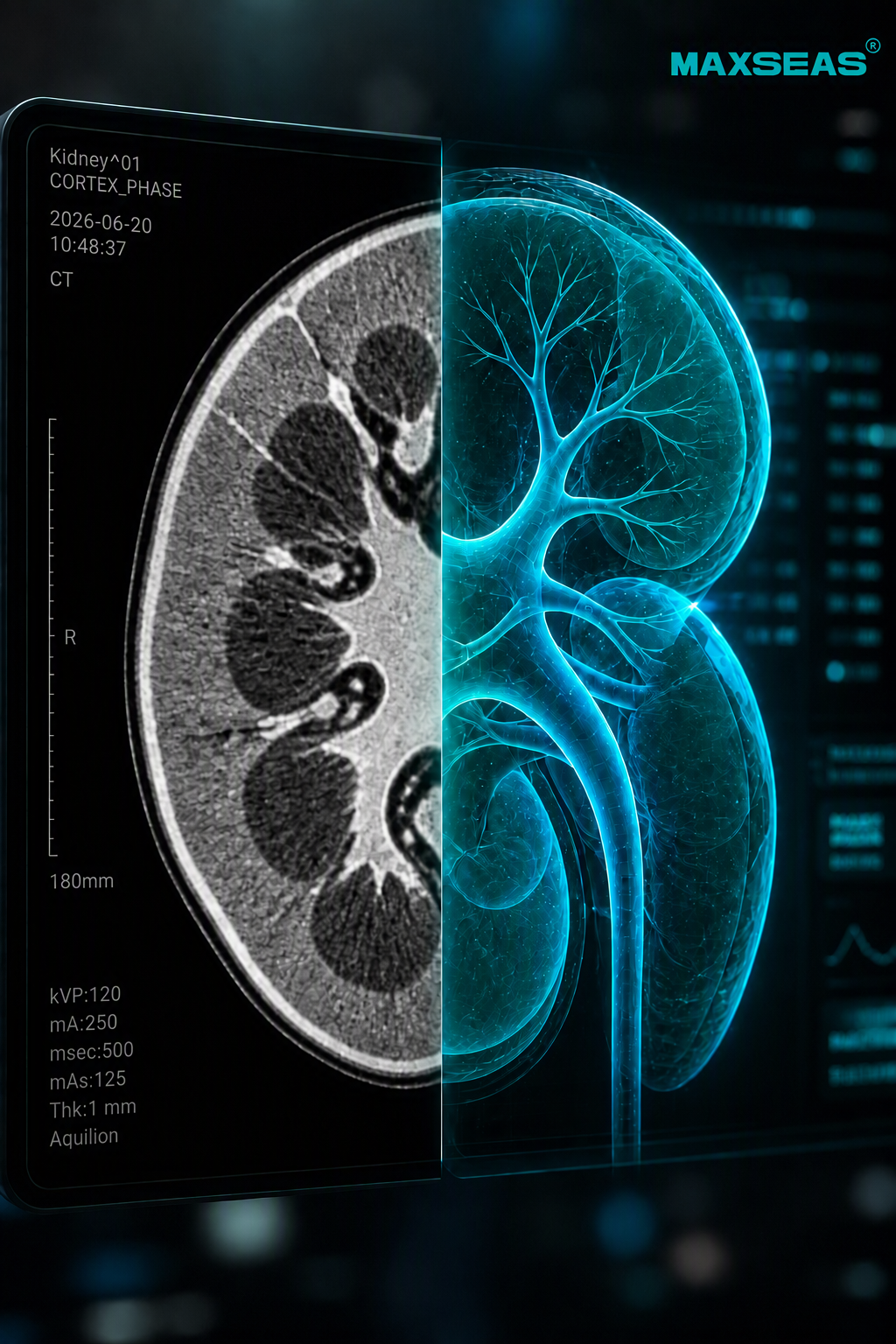
According to actual needs, the model can also be further applied to:
3D visualization and structural analysis;
Preoperative discussion and path planning assistance;
Communication between doctors and patients and case presentation;
Medical teaching and training;
Scientific research measurement, experiments and result presentation;Medical device design, adaptation and testing;Subsequent 3D printing and physical model production.
It is particularly important to note that modeling is not diagnosis and cannot replace a doctor's clinical judgment. It is more like a bridge that connects medical imaging, clinical needs, scientific research analysis, teaching training, and product development, enabling abstract data to have a clearer spatial expression.
【Medical Modeling | Audience Overview】
Medical modeling is not limited to serving a specific department or a particular project. As long as the project involves complex anatomical structures, individualized data, three-dimensional presentation or physical models, there will be a modeling requirement.
1.Hospitals and Clinical Doctors
For the clinical team, complex cases usually exhibit significant individual variations. The location of the lesion, the direction of blood vessels, the shape of the organ, and the relationship of the surrounding tissues all may influence the discussion of the treatment plan.
MAXSEAS can conduct individualized three-dimensional reconstruction based on patient's CT/MRI data according to project requirements, and also supports the creation of physical models. It provides visual assistance for the following tasks:
· Observation and preoperative discussion of complex cases;
· Three-dimensional presentation of integrated solutions in multidisciplinary consultations (MDT);
· Intuitive explanation of surgical plans during doctor-patient communication;
· Clinical teaching, review of typical cases, and academic exchanges.
In departments involving complex tubular structures or blood vessels such as urology, gastroenterology, respiratory endoscopy, and cardiovascular surgery, the three-dimensional models can transform planar information into spatial relationships. For instance, when dealing with complex calculi or kidney structures, the models can present the target area and its surrounding relationships as needed, helping the clinical team be well-prepared.
2.Research Institute
The research project requires morphological observation, size measurement, structural annotation and high-precision visual expression. The medical modeling service can assist researchers in completing the following tasks:
· Supporting the fine reconstruction and three-dimensional shape measurement of structures such as lesions, bones, soft tissues, and blood vessels;
· Supporting model annotation, data extraction, and structural comparison, providing precise digital support for data analysis;
High-quality illustrations for research reports, paper figures, and result presentations.
For the research team, the model is not merely a file; it is also a spatial research tool that can assist in analysis and provide support for arguments.
3.Medical Colleges/Universities
There is a cognitive barrier between traditional textbooks and limited specimen resources. Medical modeling models can serve as a supplement to digital teaching and training:
· Customized modeling and three-dimensional presentation of common and rare anatomical structures;
· Digital resources for medical teaching, demonstration, and course presentation;
· Reusable models for skill training.
When students can rotate, disassemble the models and observe their internal structures, spatial cognition will become intuitive and the learning threshold will be significantly lowered.
4.Medical Device Manufacturing Enterprises
The development of medical devices needs to take into account both anatomical features and product design. Medical modeling can provide the following for device manufacturers:
· Reference and visual alignment of anatomical structures at the design stage;
· Model support for adaptation testing and structural verification;
· Intuitive materials for market communication, clinical training, and product presentation.
A precise three-dimensional model enables doctors to express their requirements more intuitively and allows the R&D team to detect any deviations in the design earlier.
【Medical Modeling | Project Progression Process】
From data to physical objects, MAXSEAS employs rigorous processes to ensure that each model can precisely serve both clinical and research purposes.
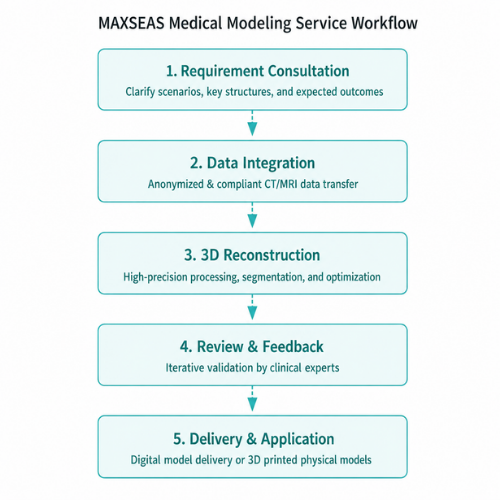
A good modeling service is not just about creating the model; it is about starting from understanding the requirements, continuing throughout the process until the model is delivered for use, and remaining in sync with the client throughout.
【Medical Modeling | What modeling services can MAXSEAS provide?】
According to the project goals of different clients, MAXSEAS can provide collaborative services ranging from digital modeling to physical model production.
1.Three-dimensional Reconstruction of Medical Images
Based on the relevant data provided by the client such as CT and MRI, the data of the target organ, tissue, lesion and surrounding structures are processed and three-dimensional reconstructed to form a model that can be used for viewing, communication, analysis or subsequent production.
2.Individualized Case Modeling
For complex cases, rare cases or projects with clear individual differences, customized modeling is carried out around the anatomical areas of concern to the clients, with a focus on presenting the target structure, lesion morphology and their spatial relationships.
3.Clinical Preoperative Planning Assistance Model
In response to the clinical discussion needs, we offer support for the creation of digital or physical models, helping doctors observe complex structures from a more intuitive perspective, discuss surgical paths, and be used for doctor-patient communication and case exchanges.
4.Medical Teaching and Training Model
Based on the course, teaching or training objectives, support the development of models for anatomical structures, typical lesions and specific training scenarios, and explore the combined application of digital models, physical models and multi-material 3D printing in teaching.
5.Research Three-dimensional Model and Experimental Carrier
Based on the research subjects, experimental goals and display requirements, assist in completing structural reconstruction, model output and prototype production, providing support for scientific research analysis, experimental design, academic presentations and result displays.
6.Medical Device Compatibility and Testing Model
Based on the development of the equipment and its application scenarios, relevant models of human body structures, target areas or lesion forms are provided to facilitate discussions on product design, adaptation verification, internal training and communication presentations.
7.Multimaterial 3D Printing and Physicalization Presentation
For projects that require physical models, based on the model structure and usage purpose, further discussions can be conducted on materials, colors, transparency effects, combinations of soft and hard structures, and printing methods, etc. This will transform the digital model into an observable, touchable, and communicable physical model.
The specific delivery format, model details, material plans, file formats, production cycle and quotation will be evaluated and confirmed based on data quality, structural complexity, usage scenarios and project requirements.
【Medical Modeling | Why Choose MAXSEAS?】
MAXSEAS has been deeply engaged in the cross-field of medical 3D printing and medical health, providing medical model solutions centered around "highly realistic reproduction and precise customization".
Relying on medical 3D printing technology, MAXSEAS can receive customer CT/MRI image data, conduct three-dimensional reconstruction and customization based on project requirements, and further support model creation in clinical, research, teaching and medical device development scenarios. From a medical image to a model that can be observed, discussed, measured, printed and used, MAXSEAS hopes to do more than just modeling; it aims to help customers truly transform the data into valuable three-dimensional tools.
【Medical Modeling | Final Thoughts】
Medical modeling is designed to make complex information more understandable, facilitate consensus among different roles, and enable a single set of imaging data to have more application possibilities.
From two-dimensional images to three-dimensional models, from digital reconstruction to physical presentation, MAXSEAS hopes to work together with hospitals, doctors, research teams, medical colleges and medical device companies to transform every specific requirement into clear, communicable and implementable medical model solutions.