Dongguan Maxseas Medical Technology Co., Ltd.

MAXSEAS | Medical Simulation Training Boosts Thoracoscopic Skill Development
【Introduction】
Minimally invasive thoracoscopic surgery is a key technique for the diagnosis and treatment of pleural diseases. It is widely used for pleural exploration, biopsy, and lesion removal. It is a necessary skill for respiratory and thoracic surgeons. However, this technique has a relatively steep learning curve.
Practical operation requires high proficiency in anatomical judgment, puncture sensation, and identification of the internal cavity view. In real clinical settings, novices are not allowed to repeatedly make mistakes. Traditional teaching methods such as diagrams and specimen demonstrations are difficult to replicate the actual thoracic space and diverse pathological scenarios. How to accumulate practical operation experience in a safe environment and shorten the learning curve for physicians has become a practical issue that needs to be addressed urgently in thoracic endoscopy medical education.
【The scale of the highly realistic simulation system】
Many people tend to equate simulation with appearance similarity. However, for simulation systems designed for clinical skills training, the evaluation criteria are never about visual replication, but rather whether they can accurately reproduce the complete clinical operation logic.
Based on the complete operation process of internal medicine thoracoscopy, a set of practical simulation training system should have the following core indicators:
1. Based on real clinical images
The foundation of the simulation is based on the real human anatomy. Simulations that are divorced from real clinical imaging data are merely artistic renderings that cannot accurately reproduce the real anatomical relationships of the chest wall and pleural cavity. Their training value would be greatly diminished. The real imaging base is the prerequisite for all clinical simulations.
2. Reconstruction of the puncture access route and the anatomical operation feedback of the chest wall
The first step in thoracoscopic surgery is chest wall puncture. A high-quality training system requires the restoration of the hierarchical perception during the puncture process, the replication of the operational sensation brought about by rib anatomy, allowing trainees to experience the operational logic of layer-by-layer approach and establish correct puncture sensation memory.
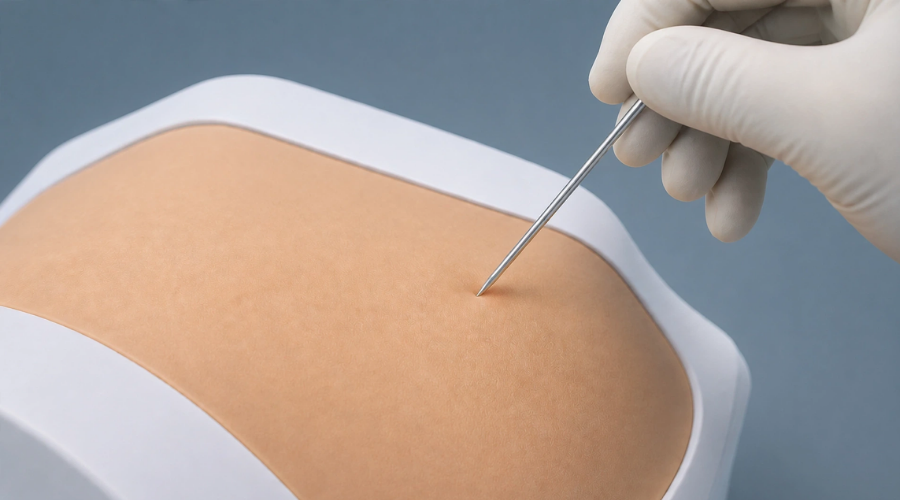
3. Reversible dynamic state of the thoracic cavity
During a real surgical procedure, a specific internal working space is formed within the thoracic cavity. The training system needs to be able to replicate the corresponding cavity state, restore the actual field of vision after the endoscope enters the thoracic cavity, enable doctors to become familiar with the internal observation perspective, and establish the spatial orientation within the thoracic cavity.
4. Highly realistic clinical texture of pleural tissue
The identification of the state of the pleura is the core part of thoracoscopic operations. The simulation system needs to reproduce the true appearance of pleural tissue to assist trainees in distinguishing between normal tissues and abnormal lesions, and to train their ability to make judgments and identifications under the microscope.
【MAXSEAS Plan】
Based on the practical problems in the training of internal medicine thoracoscopy, MAXSEAS has always focused on the construction of clinical-oriented medical education and training simulation solutions. We believe that high-quality simulation training is not merely a mechanical replication of anatomical forms; its core value lies in the restoration of progressive operational feedback: from the sense of tissue resistance during the puncture approach, to the spatial recognition in the endoscopic field, and to the practical experience in handling complex lesions.
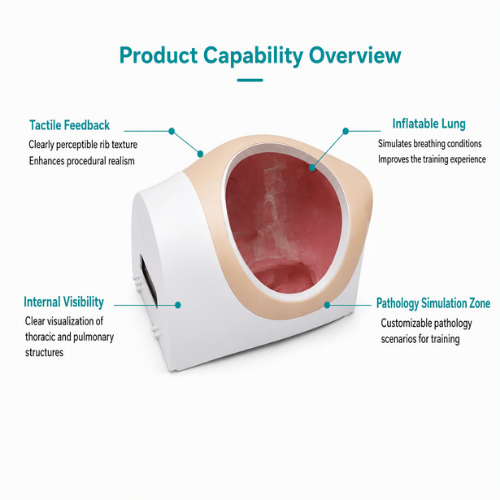
Based on real clinical data, the MAXSEAS simulation thoracoscopic model not only accurately replicates the feel of the pleura, but also supports dynamic simulation of the lung cavity and customization of various pathological scenarios such as pulmonary bullae and proliferative lesions.
We are committed to creating a safe, convenient and highly realistic non-clinical training environment, enabling physicians to repeatedly refine the entire process of approach puncture, intracavitary observation and lesion treatment. Through the ultimate pursuit of complete clinical feedback, MAXSEAS helps medical institutions implement standardized skill training and accompanies practitioners in efficiently crossing the learning threshold of internal medicine thoracoscopy technology.
【Looking forward to the future】
High-fidelity simulation training does not replace clinical practice; instead, it provides learners with more secure, efficient, and repeatable training opportunities outside the actual medical environment.
Not only thoracic endoscopy, but also in the current era of rapid popularization of endoscopic minimally invasive techniques, more and more departments are facing similar training challenges. From urological endoscopy, bronchoscopy, to thoracic internal medicine thoracoscopic surgery, each type of minimally invasive operation has its own anatomical logic, operational feel and learning threshold.
In the future, as 3D printing, digital modeling and intelligent simulation technologies continue to integrate, medical training will have more innovative possibilities. MAXSEAS will also continue to explore the combination of medical technology and educational scenarios, providing more support for medical talent cultivation.