Dongguan Maxseas Medical Technology Co., Ltd.

MAXSEAS | Standardized Simulation Training for Bronchoscopy
Bronchoscopy technology is a core minimally invasive diagnostic and therapeutic method in the field of respiratory medicine, widely used for airway examination, biopsy, foreign body removal, and interventional treatment. Familiarity with the complete anatomical pathway from the upper respiratory tract to the bronchus is the foundation for proficient operation of flexible bronchoscopy. From the nasal cavity, throat, passing through the glottis to the trachea, and then further into each level of bronchi, every anatomical turning point tests the operator's sense of touch. Traditionally, relying on patients' practical practice exercises was risky and had limited opportunities. Standardized simulation training models have become the mainstream solution for endoscopic training.
【Human Airway Anatomy for General Public Understanding】
Bronchoscopic intervention is a highly specialized type of endoscopic procedure. The airway space is narrow, the branches are complex, and the structures are intricately nested. If novice physicians are not familiar with the anatomical pathways, they are highly likely to encounter problems such as instrument obstruction during insertion, incorrect vision judgments, and operational deviations. This not only prolongs the learning period but also increases the clinical operational risks. Mastering the complete anatomical structure of the airway is the core prerequisite for standardizing endoscopic techniques, avoiding operational risks, and improving diagnostic and therapeutic skills.
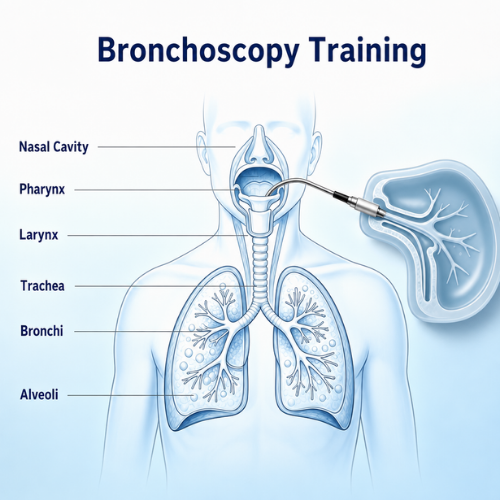
Nasal cavity: A common entry point for bronchoscopy, the channel is curved, and the operation requires gentle movements
Pharynx: The nasopharynx and oropharynx areas, the mirror body angle needs to be flexibly adjusted to avoid mucosal irritation and damage
Larynx: The vocal cord area is a critical checkpoint, it is the most core and difficult passage point in bronchoscopy operations
Trachea: The straight main trunk airway, extending downward and bifurcating into left and right main bronchi, it is the core airway passage
Bronchi: Multiple levels of fine branches, precisely corresponding to each lung lobe and segment of the lungs, it is the core area for lesion exploration
Lung alveoli: The terminal key structure of the lungs, also the high-incidence area for inflammation, nodules, and lesions
The flexible bronchoscope is inserted through the natural body orifices and the entire process is completed through visual operation. The operator must master the core skills such as rotating, advancing and adjusting the angle of the instrument, and precisely adapt to the anatomical direction of the airway, in order to smoothly reach the target bronchus and complete various clinical operations such as exploration, biopsy and interventional treatment.
【Clinical Training Pain Points】
There are numerous limitations in clinical practical scenarios:
There is a shortage of clinical patient resources, and novice physicians lack opportunities for repeated practical exercises, resulting in a slow learning curve.
Real clinical practice involves risks such as mucosal damage, choking coughing, and bleeding, with an extremely low tolerance rate.
The human anatomical structure varies from person to person, making it impossible to create standardized and repeatable training scenarios.
Conventional clinical practical exercises are difficult to replicate various typical lesions such as polyps, airway stenosis, and lesion proliferation, and the training content is monotonous.
Bronchoscopic intervention is a kind of refined endoscopic operation. The airway space is narrow, the branches are complex, and the structure is intricately nested layer upon layer. Standardized and repeatable simulation training is the optimal solution to shorten the learning curve, standardize endoscopic techniques, and enhance surgical proficiency.
【MAXSEAS's Bronchoscopy Intervention Training Model】
To meet the clinical training and instrument testing requirements for respiratory endoscopes, the MAXSEAS bronchoscopy intervention training model is made of highly realistic soft silicone material. It precisely replicates the real anatomical shape, elastic properties and structural arrangement of the human airway, and perfectly matches the feel of actual clinical operations.
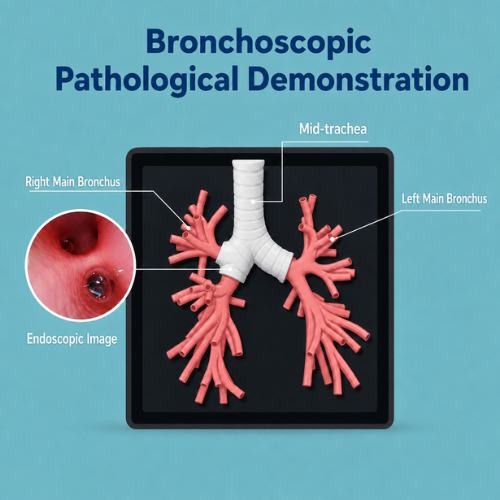
Highly realistic soft tissue materials, with a touch sensation close to the human airway
Compatible with soft bronchoscopes, simulating the entire process of oral/nasal intubation training
Can be used for intubation practice, searching for various levels of bronchi, simulating biopsy, and performing interventional operation training
Portable box design, suitable for in-hospital training and demonstration at academic conferences
Supports customization of various lesion modules such as airway stenosis, tumor lesions, and foreign bodies
【Summary】
Bronchoscopy operations start with anatomical knowledge and are refined through repeated practical training.
MAXSEAS focuses on the research and development of high-precision medical simulation models. Besides the training models for respiratory airways and bronchoscopy, it can also provide a wide range of internal medicine simulation models for ear-nose-throat, digestive, and urinary systems, and supports personalized scenario customization and the configuration of multi-disciplinary training solutions.