Dongguan Maxseas Medical Technology Co., Ltd.

MAXSEAS | Analysis of Industry Trends in Anatomical Modeling
In the past, medical education relied on two-dimensional diagrams, plastic models, and cadaver dissections to help doctors and students understand the complex human anatomy. Nowadays, with the development of 3D printing, digital modeling, VR/AR virtual simulation, and patient-specific modeling technologies, human anatomy models are undergoing a profound technological transformation.
Anatomical modelling is no longer merely an auxiliary tool in medical education; it is becoming an important technical platform that connects medical education, clinical diagnosis and treatment, surgical planning, medical device research and development, and scientific research innovation.
According to market analysis data released by OMR Global: The global anatomical modelling market size reached 365 million US dollars in 2025, and is expected to grow to 680 million US dollars by 2035, with a compound annual growth rate (CAGR) of 6.4% from 2026 to 2035.
Rather than merely focusing on the market figures, what is more worthy of our attention is the technological transformation happening across the entire industry behind the data.
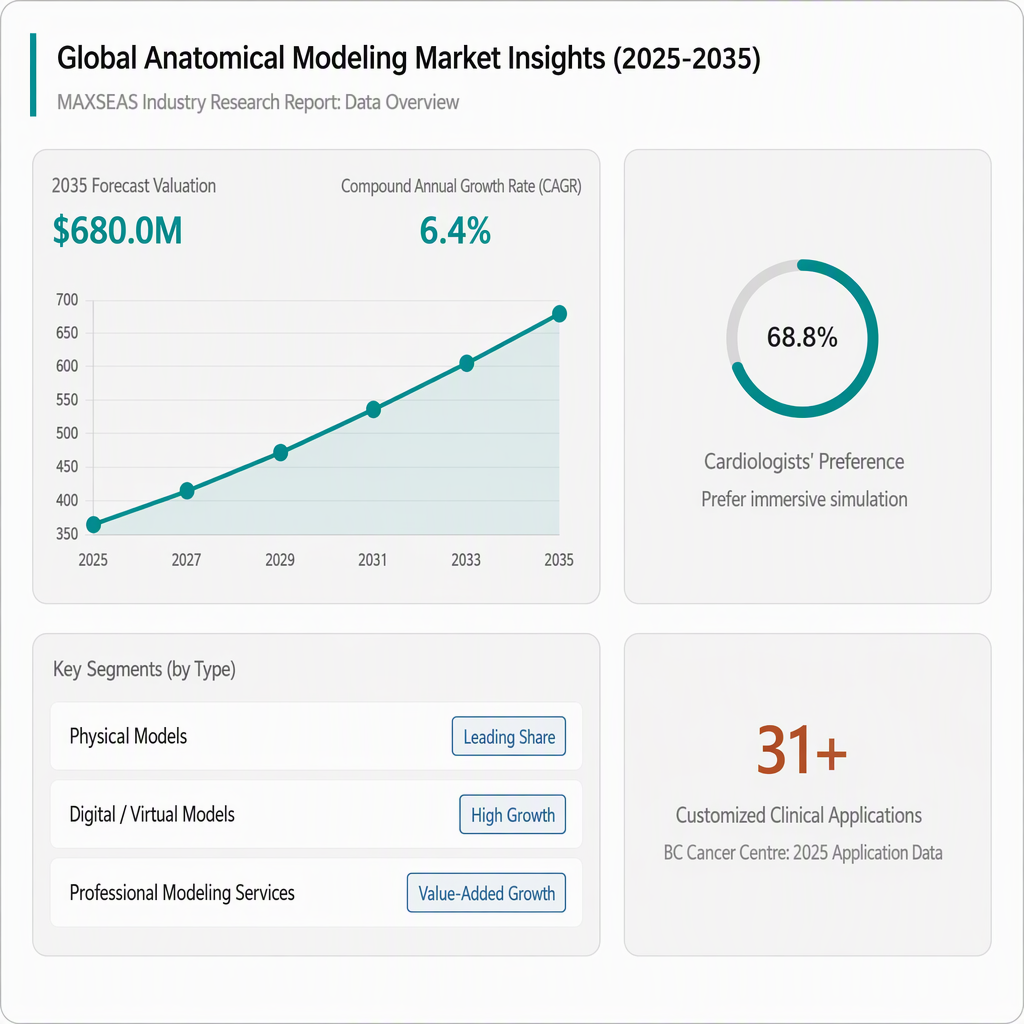
【The factors driving the rapid growth of the industry】
The iterative development of 3D printing technology, the widespread adoption of VR/AR immersive simulation, the surge in the demand for individualized patient models, and the continuous advancement of minimally invasive surgical procedures have all contributed to driving the market forward.
· 3D Printing Technology: Making Human Structures "Touchable and Real" Traditional standardized models are unable to reflect individual differences. However, 3D printing technology, based on medical imaging data (DICOM), converts the patient's actual anatomical structure into a high-precision physical model. Through touch and manipulation, doctors can more intuitively understand the spatial adjacency relationship between the lesion and surrounding blood vessels and nerves, and detect risks before the operation.
· Digital Modeling and VR/AR: Driving the Upgrade of Medical Learning Methods By combining digital modeling with VR/AR, students and doctors can observe the human body from a 360-degree perspective and repeatedly simulate complex operations in a virtual environment. Compared to traditional methods, this provides a more immersive interactive experience.
· Patient-Specific Models (PSM): In the trend of patient-centeredness, exclusive anatomical models provide strong support for complex surgical planning and personalized treatment plans. Every patient is unique, and precise modeling makes the plans more realistic.
The industry has set higher standards for anatomical models: higher anatomical fidelity, realistic tissue feel, support for customized development, repeatable practicality, and alignment with real clinical scenarios. The limitations of traditional specimens and standardized models are becoming increasingly evident, and innovative solutions are being implemented.
Taking industry cases as an example, on February 2026, Stratasys launched a multi-material 3D printing preset solution for dental anatomical models, used for simulation teaching and clinical training. This solution produces highly realistic and customizable anatomical models, serving as an alternative to traditional training models and has already been put into use in clinical teaching scenarios.
【The deep application fields of anatomical modeling】
1. Medical Education and Training
Medical education is one of the most mature application fields of anatomical models. The physical anatomical models made through 3D printing can break through the limitations of two-dimensional images and present the complex human structure in a three-dimensional way, making it easier for learners to intuitively study the skeletal structure, vascular system, nerve pathway distribution, and spatial adjacency relationships of key anatomical knowledge.
2. Surgical Planning and Simulation
For complex fields such as cardiovascular, orthopedic, neurosurgery, and oncology surgery, precise preoperative planning is particularly important. The individualized 3D anatomical models generated based on the patient's CT/MRI images can 1:1 reproduce the patient's real anatomical form. Doctors can use the models to carefully analyze complex anatomical structures and plan the optimal surgical approach and operation path.
3. Patient Communication and Medical Education
Complex diseases are often difficult to explain through language. 3D physical models have the advantage of visualization. Doctors can use the models and family members to clearly show the location of the lesion, the association between the lesion and surrounding organs and tissues, and the proposed treatment methods, etc.
North America is currently still the dominant market for anatomical modeling in the world. With a mature 3D printing industry chain and a complete medical system, the number of in-hospital self-built 3D printing laboratories is increasing continuously. A large number of hospitals have begun to use patient-customized models to complete complex surgical rehearsals. At the same time, investment in medical education and simulation medicine in the Asia-Pacific region is also releasing huge growth potential.
【Under the trend, the positioning of MAXSEAS】
Facing this rapidly growing global market, MAXSEAS has always been at the forefront of industry innovation. We not only focus on the model itself, but also on its clinical relevance.
At the high-fidelity level, MAXSEAS adheres to the realistic texture reproduction of the human body. Whether it is presenting the fine textures of the tube wall in endoscopic models, or simulating the dilation and resistance of the ureter in complex urological surgeries (such as fURS/RIRS), the MAXSEAS simulation models can provide operational feedback that is in line with clinical practice, allowing doctors to experience the puncture, insertion of the instrument, and stone fragmentation operations on the simulation platform, which maximally aligns with the real environment of the operating room, ensuring that the training and simulation results can effectively transfer to real clinical surgeries.