Dongguan Maxseas Medical Technology Co., Ltd.

MAXSEAS | Reading Your Body’s Warning Signals for Endoscopy Evaluation
Cautionary Note: This series of endoscopy-related articles is intended solely for medical industry education and sharing of clinical training knowledge. All the content in the articles cannot replace the diagnosis and medical treatment plans provided by professional doctors. If you have any related health questions, please seek medical attention at a formal medical institution promptly.
【Introduction】
The signals sent by the body are often treated as minor problems and dismissed carelessly. Abdominal distension, bloody stool, prolonged coughing... Many people hold the attitude of "just tough it out and it will pass", missing the opportunity to detect the problem early. Endoscopy is an important means to explore the true condition inside the body, but it is not necessary to perform it immediately whenever there is discomfort. Today, MAXSEAS will talk to you about which body signals indicate that you need to consider further endoscopy examinations.
【Signals related to the digestive tract】
Digestive tract problems are also the most widely applied area for endoscopy. In the following situations, do not merely rely on medication for relief:
1. Repeated upper abdominal discomfort
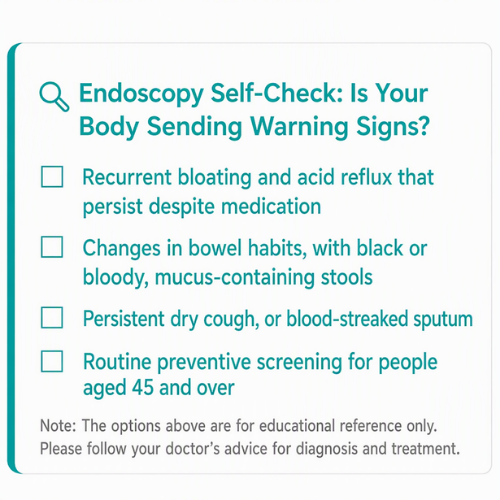
Frequent stomach pain, bloating, acid reflux and heartburn, persistent fullness after meals, loss of appetite, and even unexplained nausea and vomiting. Especially after dietary adjustments and symptomatic medication, the symptoms still recur frequently. Doctors usually assess whether a gastroscopy is necessary.
2. Obvious changes in bowel habits
The defecation pattern has changed significantly compared to before: alternating diarrhea and constipation, the stool becomes thinner, and there is a persistent feeling that the stool is not completely expelled, and this condition persists for several weeks without improvement.
Blood in stool, black stool, and mucus in stool. Many people would directly attribute it to hemorrhoids bleeding, but in addition to hemorrhoids, intestinal polyps and mucosal damage can also cause bleeding. It is difficult to distinguish them just by looking with the naked eye, and an endoscope is needed to clearly see the actual situation inside the intestinal tract.
3. Unexplained weight loss and anemia with fatigue
Without any deliberate dieting or exercise, the weight dropped significantly in a short period of time. Frequent fatigue and dizziness were observed, and an unknown cause of anemia was detected. It is possible that there is chronic bleeding or a lesion in the digestive tract, and further investigation is needed.
【Signals related to the respiratory tract】
Coughing does not necessarily mean that an endoscopy is necessary. However, in some cases where the condition persists despite treatment, a more in-depth examination of the airway interior is required.
1. Long-term persistent cough with unsatisfactory results from conventional treatments;
2. Repeated coughing up of phlegm, with blood streaks in the phlegm;
3. Imaging studies revealed abnormalities in the airways and lungs, and it is necessary to clarify the actual condition within the airways.
【Abnormal signals in the urinary system and other cavities】
1. Abnormal urination: Recurrent hematuria, difficulty in urination. It is necessary to assess any lesions in the bladder and other areas. The doctor can determine whether a bladder endoscopy is required.
2. Chest discomfort related to the chest cavity, imaging results indicate abnormal pleura. Based on the condition, the necessity of an interventional thoracoscopy can be evaluated.
【Important Reminder】
Don't force yourself to fit into a certain role and insist on having an endoscopy.
The appearance of these symptoms does not necessarily mean one is ill, nor does it imply that an endoscopy must be performed.
The symptoms are merely clues. Ultimately, a specialist doctor needs to make a comprehensive judgment based on your age, past medical history, family history, and imaging test results before deciding whether to conduct an endoscopy and which type of endoscopy to perform.
Many of the early-stage lesions show no symptoms such as pain or discomfort. This is why it is advocated that high-risk individuals should take the initiative to undergo screening. Having symptoms serves as an alarm, while regular screening for those without symptoms is equally significant.
【MAXSEAS】
As an enterprise deeply engaged in medical 3D printing and medical modeling, MAXSEAS not only focuses on creating physical models, but also concentrates on how to convert medical data into simulation training models. We integrate medical image analysis, 3D modeling, 3D printing and simulation material technologies, and develop simulation models suitable for various teaching and skill training needs in diverse scenarios.
In response to the clinical teaching needs of multi-disciplinary endoscopes, MAXSEAS has developed an endoscope training model series. It uses 3D reconstruction to restore the real anatomical features of the cavity, reproduce normal anatomical structures and typical lesion shapes, and builds a highly realistic simulation training platform.
By using these simulation training models, physicians can conduct repeated practice without involving real patients, familiarizing themselves with the path of the cavity and the visual characteristics under the endoscope, honing their practical skills, and laying a solid foundation for real clinical endoscopic operations.